What type of chargers does NZ have for public use?
New Zealand has charging stations with both AC (Alternating Current – Slower Charging) and DC (Direct Current – Fast Charging).
AC Electric Vehicle Chargers
Alternating Current – Slower Charging
Electric vehicles have an “onboard charger” though it really is a converter. It converts power from AC to DC and then feeds it into the car’s battery. This is the most common charging method for electric vehicles today and most chargers use AC power.
It is recommended by the NZTA that AC charging stations provide a Type 2 socket; the driver will be expected to provide their own supply cable that is compatible with their vehicle inlet.
If you have a Type 1 EV, carry a Type 2 to Type 1 lead. If you rent an EV, make sure that your rental comes with one for your holiday. If you have a Type 2 EV, carry a Type 2 to Type 2 lead.
DC Electric Vehicle Chargers
(Direct Current – Fast Charging).
Unlike AC chargers, a DC charger has the converter inside the charger itself. That means it can feed power directly to the car’s battery and doesn’t need the onboard charger to convert it. DC chargers are bigger, faster, and an exciting breakthrough when it comes to EVs.
The NZTA recommends that DC charging stations provide tethered cables with both the CHAdeMo DC and DC CCS Type 2 connector type. You won’t be able to get a fast charge at a DC public charging station if your car doesn’t have the matching DC charging port/inlet.
Is DC charging faster?
Yes. DC chargers are designed to deliver high power levels, typically ranging from 50 kW to 350 kW, allowing an EV to charge much more quickly. Depending on the charger and the vehicle’s battery capacity, DC charging can often provide 80% charge in as little as 20-30 minutes.
Can I get DC ‘fast’ charging at home?
The short answer is no. A DC fast charger is designed for industrial and commercial settings. This is mostly due to the power requirements and expenses associated with a Level 3 charger.
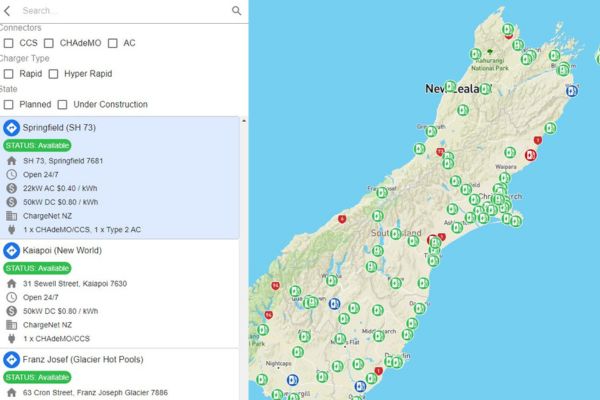
Planning your journey with an app
Access to up-to-date info via apps such as PlugShare, or A Better Route Planner provides you with lots of useful information, such as:
- Is the charging station available for use at the moment?
- Is there any cost ? – For example, it may be free but restricted to BUSINESS customers
- How do I find the charging station exactly? For example: Two car parks outside The Warehouse. Car park time limits apply.
- Description of phase. For example: 50kW DC, up to 43kW AC.
- Quantity of sockets. For example: Two 7kW AC Type 2 socketed charging stations.